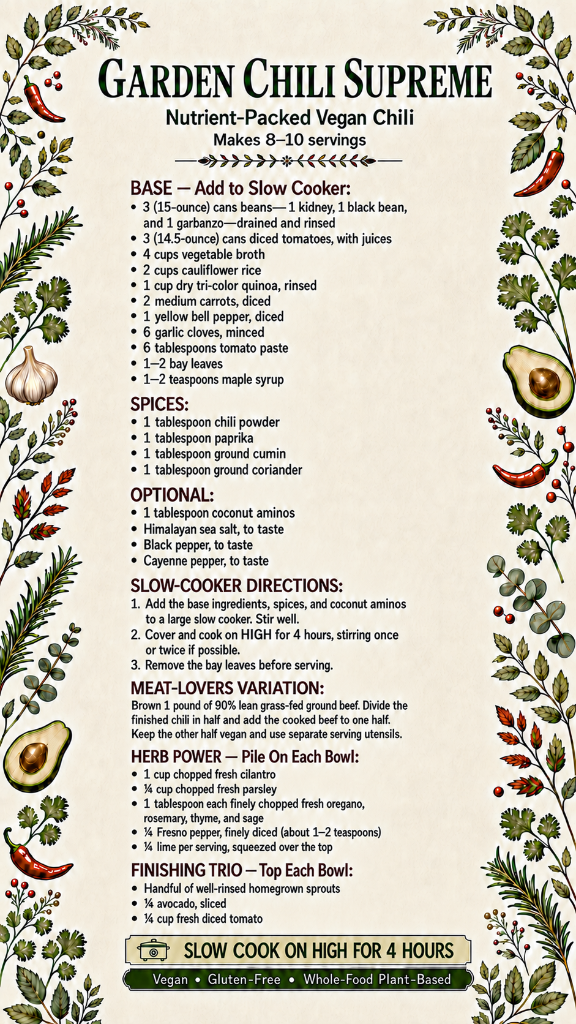
Garden Chili Supreme: Herb Power and Food That Loves You Back
By Heather Evans
What if a warm, comforting bowl of chili could also deliver an extraordinary variety of vegetables, herbs, vitamins, minerals, and healing plant compounds?
That is the inspiration behind my Garden Chili Supreme.
The slow-cooked chili creates the warm, grounding foundation. Then I cover each bowl with fresh cilantro, parsley, oregano, rosemary, thyme, sage, homegrown alfalfa sprouts, tomato, avocado, Fresno pepper, and lime.
This final layer is not decoration. It is the part that makes the chili supreme.
More Plants, More Nutritional Variety
This recipe brings together a wide range of whole plant foods.
Tomatoes provide vitamin C and lycopene. Carrots contribute beta-carotene. Bell peppers and Fresno peppers bring vitamin C and colorful plant pigments. Cauliflower provides vitamin C, folate, and naturally occurring compounds found in cruciferous vegetables. Garlic contributes distinctive sulfur-containing plant compounds.
Then we add the fresh toppings.
Homegrown alfalfa sprouts are young, vibrant plants that add freshness, enzymes, vitamins, minerals, chlorophyll, carotenoids, saponins, phenolic compounds, coumestrol, and other phytoestrogens. They also contribute vitamin K and small amounts of vitamin C, folate, iron, magnesium, calcium, copper, manganese, and zinc.
Avocado is an amazing whole food that brings creaminess, fiber, potassium, folate, and its own array of protective plant compounds. Fresh tomato and lime add brightness, color, and another layer of nutrients.
That diversity is part of its power.
Herb Power: The Part That Makes This Chili Supreme
Herbs are often used as a tiny garnish. I use them as food.
My Herb Power topping includes fresh cilantro, parsley, oregano, rosemary, thyme, and sage—many of them picked directly from my garden.
Cilantro and parsley contain vitamins, minerals, antioxidants, and naturally occurring phytochemicals. Parsley provides vitamins A, C, and K, along with folate and an impressive variety of minerals. Cilantro contributes vitamin K, vitamin C, carotenoids, and aromatic plant compounds.
Oregano, rosemary, thyme, and sage each have their own distinctive collection of polyphenols, aromatic oils, and other phytochemicals. Compounds such as rosmarinic acid and thymol are among the many reasons herbs have been valued in traditional food and wellness practices for generations.
I believe plants, herbs, and wild foods can help us heal and thrive.
What I notice is that adding generous amounts of fresh herbs dramatically increases the flavor, variety, and nutrient density of an ordinary meal.
That is why I call it Herb Power.
Inspiration and Further Reading
My appreciation for the deeper healing qualities of herbs has been strongly influenced by Anthony William, the Medical Medium.
His teachings describe parsley as a deeply remineralizing and alkalizing food, with specialized mineral salts and a much broader role in supporting the body than most people realize. He describes cilantro as an important cleansing herb with phytochemicals and mineral compounds that support the body's efforts to remove heavy metals.
If you would like to explore his perspective, I recommend:
I am grateful for these teachings and happy to give credit to a source that has shaped how I think about herbs and healing foods.
Why I Add the Herbs at the End
I pile the herbs onto each individual bowl after the chili has finished cooking.
This keeps them raw, fragrant, bright, and fresh. Their flavor stays alive rather than disappearing into the cooked base, and some of their more delicate nutrients and aromatic compounds are protected from prolonged heat exposure.
At the same time, the cooked portion has advantages of its own. Slow cooking brings the ingredients together, softens the vegetables, and creates the deeply satisfying comfort we expect from chili.
The combination gives us the best of both worlds: warm, comforting cooked food underneath and an abundant layer of fresh plants on top.
What Changes When We Add the Toppings?
The warm chili is already full of vegetables and nutrients. Herb Power and the Finishing Trio take it to another level.
The following comparison is based on an eight-serving batch. It assumes that the Herb Power ingredients are divided across the recipe and that each bowl receives approximately one ounce of alfalfa sprouts, ¼ avocado, ¼ cup diced tomato, and ¼ lime.
| Per bowl | Warm chili alone | Toppings add | Supreme bowl | Increase | | --- | --- | --- | --- | --- | | Calories | 290 | 100 | 390 | 34% | | Protein | 14.9 g | 2.7 g | 17.6 g | 18% | | Fiber | 13.5 g | 5 g | 18.5 g | 37% | | Vitamin C | 72 mg* | 24 mg | 96 mg* | 33% | | Vitamin K | 20 mcg | 72 mcg | 92 mcg | 365% | | Vitamin A | 240 mcg RAE | 40 mcg | 280 mcg | 17% | | Folate | 221 mcg | 64 mcg | 285 mcg | 29% | | Potassium | 1,187 mg | 420 mg | 1,607 mg | 35% | | Magnesium | 132 mg | 31 mg | 163 mg | 24% | | Calcium | 99 mg | 30 mg | 129 mg | 30% | | Iron | 5.9 mg | 1 mg | 6.8 mg | 16% | | Zinc | 2.5 mg | 0.75 mg | 3.3 mg | 30% | | Copper | 0.65 mg | 0.20 mg | 0.85 mg | 31% | | Manganese | 1.46 mg | 0.20 mg | 1.66 mg | 14% | | Selenium | 5.8 mcg | 0.6 mcg | 6.4 mcg | 10% |
If the recipe is divided into ten servings, the toppings represent an even larger nutritional increase because the warm-chili portion is smaller while the toppings remain the same.
The most dramatic measurable change is vitamin K, which increases by approximately 365–457%. The toppings also increase potassium by approximately 35–44%, vitamin C by 33–41%, folate by 29–36%, and several minerals by 20–38%.
*The calculated vitamin C in the warm chili may be higher than what remains after four hours of cooking. The raw toppings could therefore supply an even greater proportion of the vitamin C in the finished bowl.
Trace Minerals in the Supreme Bowl
Trace minerals are needed in smaller quantities than minerals such as potassium, calcium, and magnesium, but that does not make them unimportant.
The measurable trace minerals in this bowl include:
- Iron, found in the legumes, quinoa, herbs, sprouts, vegetables, and spices
- Zinc, supplied by the legumes, quinoa, alfalfa sprouts, avocado, and herbs
- Copper, present in the legumes, quinoa, avocado, sprouts, herbs, and spices
- Manganese, found throughout the herbs, quinoa, legumes, avocado, and vegetables
- Selenium, present in smaller and more variable amounts
The toppings increase iron by approximately 16–20%, zinc by 30–37%, copper by 31–38%, manganese by 14–17%, and selenium by approximately 10–13%.
Parsley and other herbs may also contain molybdenum, chromium, iodine, and additional mineral traces. These amounts are strongly influenced by the soil and growing conditions and are not consistently measured in standard food databases.
This is one reason I value homegrown foods. Their story begins with the life and mineral content of the soil.
Beyond the Nutrition Label
The numbers tell only part of the story.
Standard nutrition databases can measure vitamin C, vitamin K, folate, potassium, iron, and other recognized nutrients. They cannot give us one complete measurement of the phytochemical value of a meal.
The fresh toppings introduce an entirely new collection of plant compounds:
- Parsley contributes apigenin, luteolin, chlorophyll, and carotenoids.
- Cilantro provides chlorophyll, carotenoids, quercetin-related compounds, and aromatic aldehydes.
- Oregano adds rosmarinic acid, carvacrol, and thymol.
- Rosemary contributes rosmarinic acid, carnosic acid, and carnosol.
- Thyme provides thymol, carvacrol, and rosmarinic acid.
- Sage contributes rosmarinic acid, carnosic acid, and aromatic terpenes.
- Fresno pepper adds capsaicinoids, carotenoids, and vitamin C.
- Alfalfa sprouts contribute chlorophyll, carotenoids, saponins, phenolic compounds, coumestrol, and other phytoestrogens.
- Avocado contributes carotenoids, phytosterols, glutathione-related compounds, and polyphenols.
- Tomato provides lycopene, beta-carotene, and other carotenoids.
- Lime adds vitamin C, flavanones, and aromatic citrus compounds.
We cannot accurately add these together and assign one percentage to the phytochemical increase. What we can say is that the toppings introduce numerous new phytochemical families that are absent—or present in much smaller quantities—in the warm chili alone.
The toppings do not simply decorate the chili. They transform its nutritional diversity.
What "Healing Food" Means to Me
When I call this healing food, I am not claiming that one bowl of chili cures a medical condition.
I am describing foods that give the body a broad range of resources with which to do its work: vitamins, minerals, hydration, fiber, antioxidants, phytochemicals, and the subtle qualities of fresh plants that we may not completely understand yet.
Healing comes from consistently giving the body clean, vibrant, nourishing foods and creating the conditions in which it can function at its best.
That is how I approach this chili—and how I approach nearly every meal.
Yes, it has Protein
Because people frequently ask whether vegan meals contain enough protein, here is the simple answer: this one provides approximately 15–18 grams per fully topped bowl.
It also supplies all nine essential amino acids.
We do not need to carefully combine all nine essential amino acids in perfect proportions at every meal. The body draws from the amino acids supplied by the varied foods we eat throughout the day.
Protein is present, but it is not the star of this meal. The star is the extraordinary diversity of whole plant foods and the nourishment they provide together.
Estimated Nutrition
Depending on whether the recipe makes eight or ten servings, each fully topped vegan bowl provides approximately:
- 330–390 calories
- 15–18 grams of protein
- 16–18.5 grams of fiber
- 51–62 grams of carbohydrates
- 10–11 grams of healthy fat
- A wide spectrum of vitamins, minerals, antioxidants, and phytochemicals
These numbers are estimates. Exact values will vary with serving size, ingredient brands, growing conditions, and the quantity of homegrown alfalfa sprouts used.
One Meal for Different Preferences
I am vegan, while my husband and son enjoy meat. This recipe works beautifully for all of us.
After the chili is cooked, we divide it in half. They add one pound of cooked 90% lean grass-fed ground beef to their portion, while mine remains completely vegan. We use separate serving utensils for the two versions.
It allows us to share the same nourishing family meal while honoring our individual choices.
Food That Loves You Back
Garden Chili Supreme is not about isolating one "superfood." Its strength comes from abundance and diversity: colorful vegetables, aromatic herbs, alfalfa sprouts, avocado, tomato, lime, legumes, quinoa, and warming spices, all working together.
It is flavorful, satisfying, vibrant, and deeply nourishing.
This is how I love to eat—for health, vitality, longevity, sustained energy, and joy.
This is food that loves you back.
Ready to make it?
Download the printable Garden Chili Supreme recipe card →
And if you would like to experience nourishing food like this with us, join us at the SSR in Zion National Park this October. We will be offering healthy food options that take nutrition to a whole new level, so you can feel what it is like to give your body the very best.
Begin Your Journey
Ready for The Freedom Practice™?
A free 5-day micro retreat that guides you through five powerful choices — Clarity, Release, Trust, Courage, and Transformation — to help you create a life you don't need to escape from.
Join our newsletter
Get insights like this delivered to your inbox.
Explore Soul Sister Retreat